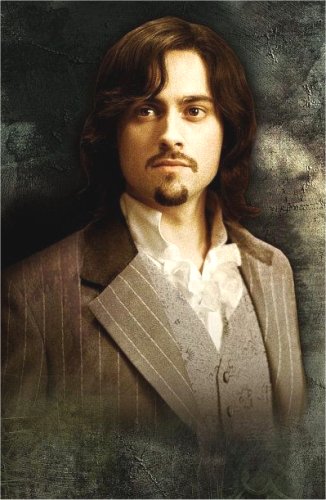
So The Picture of Dorian Gray... *sigh* I really do love this story even if the writing seems a bit muddy to me at times. However Oscar Wilde is famous for his elegant , if lengthy descriptions of the human soul and its reaction to acts of love. We often see in Dorian Gray, not just the statements of how love affects a person but of how the duplicity of the human soul can affect the very idea of love, or more often than not affection. Wilde's character, Lord Henry, stated "Those who are faithful know only the trivial side of love; it is the faithless who knows loves tragedies." (pg 14) I think that Wilde was making another statement about the human soul here, not that promiscuity was the way to go, as some of the contempories of his time believed, but a statement about loves naivety and how truly tragic love can be.
Now I love the idea's presented in pieces like Marlowe's Doctor Faustus and I can't help but see several similarities between classic Faust and Dorian Gray, and I believe that was something of a point made by Wilde. This Faustian tendency in literature of the time period was whole heartedly moralistic however I believe that Wilde had more than just simple morals on the mind when he wrote Dorian Gray. Personally I believe that Wilde was making a rather drastic set of statements on the tendencies of the English 'upper crust' to live a drastically duplicitous life. Where the idea of Victorian society was the important part no matter what vulgar or distasteful life they lived on their own. Which is only more amusing to me considering the later part of Wilde's life where he was persecuted for the life that he led but decided not to make as horribly blunt as everyone expected. Seriously though it's amazing to see Wilde's commentary on English society used against him in such a blatant fashion seeing as they even used passages from Dorian Gray in Wilde's trial in 1885. And I personally think that Wilde's defending quote from his own trial is one of the best breakdowns of the relationship between Dorian and Basil Hallward began as, "'The love that dare not speak its name" in this century is such a great affection of an elder for a younger man as there was between David and Jonathan, such as Plato made the very basis of his philosophy, and such as you find in the sonnets of Michelangelo and Shakespeare. It is that deep spiritual affection that is as pure as it is perfect. It dictates and pervades great works of art, like those of Shakespeare and Michelangelo, and those two letters of mine, such as they are. It is in this century misunderstood, so much misunderstood that it may be described as "the love that dare not speak its name."
In the end though everything breaks down. Every lie comes to truth, every act is examined for ulterior motives, and the duplicitous nature of nobility (according to Wilde) ends up being its own killer. It's funny sometimes the way that life and art are just different sides of the mirror, and you can never be sure exactly which side you're on.


Hello there!
ReplyDeleteI appreciated everything you had to say about Dorian Gray. You touched on Lord Henry and his observation that “Thos who are faithful know only the trivial side of love; it is the faithless who knows love’s tragedies.” (p.14) I agree that this is not necessarily an endorsement of the promiscuous lifestyle which it was sometimes interpreted to be among Wilde’s contemporary critics. I believe another layer of meaning exists in Lord Henry’s declaration. I imagine that those who are “the faithful” in love, those that remain committed and loyal, experience a side of love which is positive and glowing … Lord Henry might call it “trivial.” The “tragedies” of which he speaks could be the depth of the hurt, the regret, the sorrow and loneliness which might visit those who are not faithful (along with those loved by them). This was just one of way of reading into Lord Henry’s quote that I imagined might be plausible.
Anyways, I liked your analysis of how eventually Wilde came to be examined through the lens of his own commentary … it is wild to me how strange real life can be sometimes. Unfortunately, some sad stuff has been happening with my family this week so I was unable to finish the novel, but I look forward to next week!
I enjoyed the way you finished your blog by saying, "It's funny sometimes the way that life and art are just different sides of the mirror, and you can never be sure exactly which side you're on." I find a lot of truth in that.
ReplyDeleteI have never read Marlowe's work, but your connection of Doctor Faustus and Wilde's work makes me interested in checking it out. I would find it extremely hard to argue that Wilde's work was not strongly influenced by his personal life. I agree with you that he was definitely making strong statements concerning the lives of the "upper crust" of society and I suppose that leads me to not be so shocked that they used his fictional written work againt him during his trial. It's dangerous in any time period- even now, to make insinuations and present strong opinions that bring negative attention to people in positions of power, as the upperclass usually are.
Your thoughts on Wilde's presentation of the idea of love were interesting. When you said, "We often see in Dorian Gray, not just the statements of how love affects a person but of how the duplicity of the human soul can affect the very idea of love, or more often than not affection." I thought of the changing relationship between Dorian and Sybil, and how influenced it was by the nature of the characters, and in turn, how fleeting.
Overall, I enjoyed your analysis and I've now added a new book to my "to read" list.
Hi Wicked Seraph,
ReplyDeleteI enjoyed reading your post. I have to admit that some of it was a bit over my head, for example I’m not very familiar with Faust, but I thought that you raised a lot of critical points.
I found your following passage really interesting,
“This Faustian tendency in literature of the time period was whole heartedly moralistic however I believe that Wilde had more than just simple morals on the mind when he wrote Dorian Gray. Personally I believe that Wilde was making a rather drastic set of statements on the tendencies of the English 'upper crust' to live a drastically duplicitous life. Where the idea of Victorian society was the important part no matter what vulgar or distasteful life they lived on their own. Which is only more amusing to me considering the later part of Wilde's life where he was persecuted for the life that he led but decided not to make as horribly blunt as everyone expected.”
In this passage you mention Victorian society. When I did research on Oscar Wilde I found information on the aestheticism movement and how he was an advocate for aestheticism which is to go against Victorian society. Is what you’re saying is that Oscar tends to contradict himself? I’m not sure if that’s what you’re saying but if it is, I also felt that he contradicted his own values. I’ll be honest, I can’t really back up my statement here because I’m still trying to figure it all out. I think that Oscar values nonconformity, but…now I’m stuck. Haha thanks for making me critically think though, really opened up new ways of thinking for me!