Well now, thank you Mr. Alley for corroborating some of my statements from last week, specifically "Personally I believe that Wilde was making a rather drastic set of statements on the tendencies of the English 'upper crust' to live a drastically duplicitous life. Where the idea of Victorian society was the important part no matter what vulgar or distasteful life they lived on their own." Part of this is pointed out when Alley brought forward the point that homosexual references were okay in Victorian society, so long as they were 'historical' or at least seemed that way. It was only when individuals like Wilde brought those ideas to a very forward and current standpoint, in Alley's opinion, did they become scandalous to the rest of society. Wilde saw this hypocrisy and choose to point it out with Basil's reactions to Dorian as the story went on. Alley quotes Phillip K. Cohen from The Moral Vision of Oscar Wilde, "Hallward is brought to "the verge of a terrible crisis in my life" (11) because Antinous has stepped out of ancient Rome and come into the immediacy of the painter's own studio. In this sense, the bedroom is not far off," among a great many other rather interesting statements breaking down the historical significance of the relationship between Basil and Dorian. It's also nice to see that Cohen and Alley also weigh heavily on the influences that Shakespeare placed on Wilde's writing, using Shakespeare's own works as glasses through which to view Wilde's story, almost as if one is a footnote to the other in literary significance.
In all honesty I wasn't a huge fan of this article, at least not all of it, but that doesn't really matter because it redeems itself, in my opinion, in the last two paragraphs. I think Alley really put a lot of his own emotions into that small bit of writing and we see that Wilde's son is just as eloquent as he was. Vyvyan Holland refers to the tragedy of his father as a "great historical tragedy" whose basis comes from the actions of "pompous and self important people." I can only assume here that Holland is referencing the members of English society who persecuted and condemned his father, because his statements about Wilde in his second quote just don't lend themselves towards Wilde being pompous or self important.
Alley makes two amazing statements about those who now exist in society without Oscar Wilde, almost pleading with the reader to not let Wilde's actions and persecution just sit idly by without any type of recourse. He's not asking for an uprising, instead he pleads for the continuation of Wilde's actions. He makes Wilde out to be an 'icon' for the gay rights movement, even before such a movement can say it existed in truth. "The catharsis of the enormous pity and fear elicited by
Wilde's extraordinary life and genius must be left to the biographers, who, like Hallward, must
celebrate once again the power of the initially beautiful painting and finish the formation of the icon." In the end there is also that plea, even though Wilde's life ended so painfully, to not allow that to be the thing that holds people back from embracing what could be a beautiful way to love, to allow those who have different feelings to strip away a duplicitous life and let people live as they truly desire.
The last note from Alley, and one of perhaps his most poignant arguments, just needs to be here to be seen.
"From the novel Women in Love through to the film Leaving Metropolis and the epic play Angels in America, the struggle for manifesting the affirming gay icon continues: it is the embrace of Hallward's "harmony and soul" that is still hungered for in those of us sympathetic to Wilde, tragedian and painter of innermost lives."
RIP
Oscar Wilde
1854 -1900
Tuesday, March 16, 2010


Tuesday, March 9, 2010
Picture Picture on the wall, who's the fairest of them all?
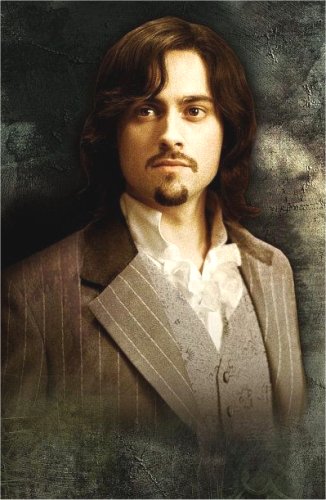
So The Picture of Dorian Gray... *sigh* I really do love this story even if the writing seems a bit muddy to me at times. However Oscar Wilde is famous for his elegant , if lengthy descriptions of the human soul and its reaction to acts of love. We often see in Dorian Gray, not just the statements of how love affects a person but of how the duplicity of the human soul can affect the very idea of love, or more often than not affection. Wilde's character, Lord Henry, stated "Those who are faithful know only the trivial side of love; it is the faithless who knows loves tragedies." (pg 14) I think that Wilde was making another statement about the human soul here, not that promiscuity was the way to go, as some of the contempories of his time believed, but a statement about loves naivety and how truly tragic love can be.
Now I love the idea's presented in pieces like Marlowe's Doctor Faustus and I can't help but see several similarities between classic Faust and Dorian Gray, and I believe that was something of a point made by Wilde. This Faustian tendency in literature of the time period was whole heartedly moralistic however I believe that Wilde had more than just simple morals on the mind when he wrote Dorian Gray. Personally I believe that Wilde was making a rather drastic set of statements on the tendencies of the English 'upper crust' to live a drastically duplicitous life. Where the idea of Victorian society was the important part no matter what vulgar or distasteful life they lived on their own. Which is only more amusing to me considering the later part of Wilde's life where he was persecuted for the life that he led but decided not to make as horribly blunt as everyone expected. Seriously though it's amazing to see Wilde's commentary on English society used against him in such a blatant fashion seeing as they even used passages from Dorian Gray in Wilde's trial in 1885. And I personally think that Wilde's defending quote from his own trial is one of the best breakdowns of the relationship between Dorian and Basil Hallward began as, "'The love that dare not speak its name" in this century is such a great affection of an elder for a younger man as there was between David and Jonathan, such as Plato made the very basis of his philosophy, and such as you find in the sonnets of Michelangelo and Shakespeare. It is that deep spiritual affection that is as pure as it is perfect. It dictates and pervades great works of art, like those of Shakespeare and Michelangelo, and those two letters of mine, such as they are. It is in this century misunderstood, so much misunderstood that it may be described as "the love that dare not speak its name."
In the end though everything breaks down. Every lie comes to truth, every act is examined for ulterior motives, and the duplicitous nature of nobility (according to Wilde) ends up being its own killer. It's funny sometimes the way that life and art are just different sides of the mirror, and you can never be sure exactly which side you're on.
Tuesday, March 2, 2010
To sleep perchance to dream.... of vampires!?
Well for the first time I read a piece of the after book analysis and I wasn't horribly disappointed by the over wordy nature of the piece, then again maybe that was just by some perceive witty remarks that I thought I found in there. Either way Michael Davis gave us a lot to think about. However since talking about everything that he went over would be not only longer than necessary, it would also most likely be duller than a doorknob. So on to the meat and potatoes.
One of my favorite bits in Davis' piece (including witty commentary) comes very near the end of page 232 and the top of page 233. Davis points out "Indeed Carmilla and her enigmatic messages, together with the anagrammatical lability of her ‘name’, are like the chimeras sold by the hunchback, ‘compounded of parts of monkeys, parrots, squirrels, fish, and hedgehogs, dried and stitched together with great neatness and startling effect’ (265); part of nature and yet beyond conventional meaning. (And is it too fanciful to suggest that ‘Carmilla’ and ‘chimera’ sound quite similar?) Thus, through the allegorising selfreflexivity of Le Fanu’s text we can see that Carmilla and the Gothic are chimerical hybrids, a stitching together of heterogeneous and thus profoundly enigmatic signifying materials." Personally I think that this is one of the most inherent things behind a truly Gothic piece of literature, being something horribly innocuous and yet totally terrifying. I decided to go and see what Wikipedia had to say about Gothic Literature, and sure enough they had a nice big list of the Prominent features of Gothic Fiction and, needless to say, the overwhelming majority of the list took place right here in Carmilla.
Now I'll jump around a little here, but that because I haven't taken enough psychology classes to make much sense some of the way that things worked out here, so I'll just stick to what I know for now. I'm not a big fan of Freud, but I know of a lot of his work. I am a big fan of Shakespeare, and I know a lot of his work as well. So when Davis stared explaining the Oedipal situation of Carmilla my mind started recognizing what he was talking about (right after it made a short leap to Oedipus Rex). Now I'll admit I was a little surprised to see the Oedipus references in this analysis, but that's mostly because I didn't see that type of relationship between Laura and her father. I saw and understood the slightly maternal interactions and relationship between Carmilla and Laura but I hadn't made the leap to Oedipal for her father, and it I missed something that he makes seem fairly obvious, I wonder where I missed it exactly.
Now one last note. I mentioned in my piece last week that I hadn't seen much of the interaction with Ireland in the stories or the characters, nor did I see an overt amount of Ireland in the stories that we had been reading. This isn't to say that I didn't see some of the political ramifications, nor the persecution of the relationship between the British, I just thought it wasn't the forefront of the pieces sometimes. I also made the point that, perhaps I wasn't seeing it because I wasn't part of the originally intended audience, and that's something that we often miss when reading over these pieces. We have the luxury of looking back on history and seeing what was going on at that time, but we weren't living it. We weren't living the subtleties of the daily interaction with the writers culture, as much as I wish I could have sometimes. So who knows, we all may be way off base with our analyses, and somewhere the authors are having a good ole giggle at us in the afterlife, or maybe we're dead on the money. Just things to contemplate as the nights wane by.
WS
One of my favorite bits in Davis' piece (including witty commentary) comes very near the end of page 232 and the top of page 233. Davis points out "Indeed Carmilla and her enigmatic messages, together with the anagrammatical lability of her ‘name’, are like the chimeras sold by the hunchback, ‘compounded of parts of monkeys, parrots, squirrels, fish, and hedgehogs, dried and stitched together with great neatness and startling effect’ (265); part of nature and yet beyond conventional meaning. (And is it too fanciful to suggest that ‘Carmilla’ and ‘chimera’ sound quite similar?) Thus, through the allegorising selfreflexivity of Le Fanu’s text we can see that Carmilla and the Gothic are chimerical hybrids, a stitching together of heterogeneous and thus profoundly enigmatic signifying materials." Personally I think that this is one of the most inherent things behind a truly Gothic piece of literature, being something horribly innocuous and yet totally terrifying. I decided to go and see what Wikipedia had to say about Gothic Literature, and sure enough they had a nice big list of the Prominent features of Gothic Fiction and, needless to say, the overwhelming majority of the list took place right here in Carmilla.
Now I'll jump around a little here, but that because I haven't taken enough psychology classes to make much sense some of the way that things worked out here, so I'll just stick to what I know for now. I'm not a big fan of Freud, but I know of a lot of his work. I am a big fan of Shakespeare, and I know a lot of his work as well. So when Davis stared explaining the Oedipal situation of Carmilla my mind started recognizing what he was talking about (right after it made a short leap to Oedipus Rex). Now I'll admit I was a little surprised to see the Oedipus references in this analysis, but that's mostly because I didn't see that type of relationship between Laura and her father. I saw and understood the slightly maternal interactions and relationship between Carmilla and Laura but I hadn't made the leap to Oedipal for her father, and it I missed something that he makes seem fairly obvious, I wonder where I missed it exactly.
Now one last note. I mentioned in my piece last week that I hadn't seen much of the interaction with Ireland in the stories or the characters, nor did I see an overt amount of Ireland in the stories that we had been reading. This isn't to say that I didn't see some of the political ramifications, nor the persecution of the relationship between the British, I just thought it wasn't the forefront of the pieces sometimes. I also made the point that, perhaps I wasn't seeing it because I wasn't part of the originally intended audience, and that's something that we often miss when reading over these pieces. We have the luxury of looking back on history and seeing what was going on at that time, but we weren't living it. We weren't living the subtleties of the daily interaction with the writers culture, as much as I wish I could have sometimes. So who knows, we all may be way off base with our analyses, and somewhere the authors are having a good ole giggle at us in the afterlife, or maybe we're dead on the money. Just things to contemplate as the nights wane by.
WS
Subscribe to:
Comments (Atom)
