Lacanian 'Pussy': Towards a Psychoanalytic Reading of Patrick McCabe's Breakfast on Pluto
Wish that there had been nothing to say...
Well if this doesn't go right along with the theme of literary criticisms being a way to give myself a migraine I don't know what does. I all honesty I think one of the most frustrating thing about this piece was once again the rampant psychobabble that filled the pages of this criticism. I do have to admit that that I really enjoyed a lot of the historical bits that were throughout the piece, but I'm a bit of a history buff. Part of the reason that I enrolled in this course was to get a more cultural grasp on Ireland and its very comforting to see something that I do know about (history and in a broader sense the political ramifications between the Irish Nationalists and Unionists) come back into play.
When it came around to the matter of "Sameness" I was actually more interested in looking up Seamus Heaney's poem "Whatever you say say nothing", (http://poetry.mirandasbeach.com/content/view/745/53/) and I just couldn't help but put most of my focus on that. This poem really is how things are, in many situations. Heaney writes quite a bit about the Troubles of Ireland and how it's affecting the everyday life of the Irish person.
Heaney comments "Yet I live here, I live here too, I sing, Expertly civil tongued with civil neighbours". In all honesty, and please don't flay me alive here, I can see similarities to what was happening in that time period to what occurred in several German occupied countries during WWII. It got to the point in Ireland where people were afraid to talk to each other, people that they had grown up next to and gone to school with were suddenly 'against' each other because they may be the wrong religion or the wrong political affiliation. For so long the " 'One side's as bad as the other,' never worse" mentality cited by Heaney caused a buildup of apathy that eventually exploded from a powder keg of political and religious bigotry that had gone unsaid for so long.
Heaney also mentions a group of people called the 'wee six' as well as Ballymurphy. The two are actually in different verses of the poem but I believe that the 'wee six' is a reference to the first six civilians killed at the Ballymurphy Massacre on August 9th of 1971. These people ranged from a catholic priest trying to help another wounded man to an Irish woman who had been standing across the street from the military base.
There are so many references to the secular behavior of Ireland made by Heaney its really impossible for me to break it all down right now... I know though that the poem was far more enlightening than the criticism.
As to my final project, I'm still tossing around a few ideas and trying to narrow down my option. I thought of doing a comic book representation of some of my favorite scenes from multiple books. I also thought about doing songs, that idea struck a chord (pun not intended) with me. I also had the idea to create a movie poster with a few tag lines for each book, or some type of movie trailer to go along with it. Like I said I'm still really tossing around ideas. Advice is more than welcome and wanted.
WS
Tuesday, April 20, 2010


Tuesday, April 6, 2010
Literary Criticism: Rhythm and Flow
A Literary Criticism of “A Portrait Of The Artist As A Young Man And The Individuating Rhythm Of Modernity” by Tobias Boes
Music has long held the key to human emotions, having the knack for evoking perhaps some of the most profound thoughts or actions. However writers like Joyce took the concepts behind music and put them to paper in ways that exhibit this link perhaps a bit better than others. Tobias Boes goes to great lengths to explain the rhythmic feeling of Joyce’s “A Portrait of a Young Artist”, and how these rhythms further the concepts of epiphany and leitmotif. He also goes into a great amount of detail to explain the polyrhythmic sense of life of a colonial city and its impact on those individuals who live in its world. We also are given the concepts of the Bildungsroman, a German writing style in which the novel explains the development or the coming of age of the protagonist through a series of events that shape the characters processes of action, as well as the ideas of the modernist writer, whose emphasis is placed on a post-agrarian, post-medieval society that is progressing into the state of industrial economy. Boes poses the thought that Joyce is somewhere between the two and spends quite a bit of time offering the view points of other authors on that very subject.
In the early portion of his analysis, Boes points out the dating of the post script offered by Joyce at the end of A Portrait (“Dublin 1904 Trieste 1914”) and comments that “A more suitable ending to a novel that similarly frustrates the conventions of the well-made plot by its constant vacillation between disjunctive and conjunctive tendencies could hardly be imagined.” (Pg 767) Boes tries to make clear, although in an overly wordy manner, that although well written Joyce’s tendency to drastically change from a wholeheartedly unrelated set of experiences to an series of linear moments is a slap in the face to conventional storytelling and yet it proved to be more than appropriate for this tale. The major tie between the postscript and Boes’ statement is the lack of continuation and implications that the writing of the novel had occurred twice by the lack of hyphening between the two dates, much like the lack of unity in a large portion of the literature. This thought also goes into some of the belief of the leitmotif, a reoccurring idea, image, or theme that predominates the piece.
The leitmotif and the epiphany are the two predominating factors of Joyce's work and a good portion of Boes' criticism is devoted to those subject. I believe that Boes spends far longer discussing the leitmotif, allowing the musical imagery triggered by the concept of the leitmotif to drastically predominate his work. However the Epiphany, and the attention given to it, are vastly important to the work. Boes implies that the manner in which Joyce separated his work into chapters was derived from the musical composition, with the leitmotif predominating and the epiphany used as a way to move from chapter to chapter, as if bracketing the musical work like the bars of a composition. We see this imagery replicated in Joyce's work as well when Stephen is on the train. The way that the telegraph poles bracket the movement of the train and the eventual movement of the passengers is as if there are musical bars, breaking up the progress of Stephen's own internal processes.
The idea of the Bildungsroman, the novel of development, as somehow being an opposition of novels of modernity however is not one that I cannot support. According to Gerald Delanty, a writer for the Blackwell Encyclopedia of Sociology, "Modernity is thus a particular kind of consciousness, which defines the present, in its relation to the past, which must be continuously recreated; it is not a historical epoch that can be periodized." Looking at this breakdown of Modernity, even sociologically there is absolutely no reason why a novel of development can't also be a novel of modernity. The fact that Joyce wrote A Portrait as a stream of consciousness style of novel supports the modernity aspect, however the journey that Stephen takes definitely a transitory approach in which we witness the development of his views as he grows into an adult. This follows the almost cookie cutter approach that is required of a novel to be considered part of the Bildungsroman style.
Perhaps one of the less expected parts of this criticism for me was the information offered about the concept of the polyrythmicality of a city and the influence it has on the individuals who live there. According to Henry Lefebvre, a French sociologist specializing in rhythmanalysis which is a study of the patterns of everyday life, "Polyrythmicality in this context should be understood as the simultaneous existence in close spatial proximity of life -worlds that place differing emphases on the linear and cyclical elements that constitute historical experience." This concept, in and of itself, is profound not just in the historical emphasis that many refer to it in. In the original rhythmanalysis, the cities studied were those of the Mediterranean, however this concept is not in any way exclusive to those locations. In every city throughout history there has been a differing rhythm and flow to the different 'sections' of a city. Whether you're listening to the low grumblings and rustlings of a back alley or the hustle and bustle of main street, there are different rhythms that operate a city. This is actually seen rather intently in Joyce's novel, as Stephen makes his way through life, growing accustomed to the rhythms of his locations and often seeking them out when he needs to change where he's going in his life.
Although it was placed in a rather difficult and jargon-y manner, Boes took his time explaining the leitmotif and the epiphany as musical components that helped make up the polyrhythmic nature of Joyce's version of Ireland, full of flavor and context which shaped our protagonist. He also drew attention to the points of style and contention often put forward by other writers, seeking to qualify Joyce into a single literary identity, which in itself contrasted the polyrhythmic concept behind the world of Joyce's novel. Simply put, Joyce's novel can't be qualified as simply a Bildungsroman or a novel of modernity, or many other things, because (time for an epiphany) it is all of those. That sense of being and non being, of existing on many levels at once is one of the greatest underlying leitmotifs of Joyce's work.
Works citied:
James Joyce, A Portrait of the Artist as a Young Man (London: Penguin, 1993)
A Portrait of the Artist as a Young Man and the "Individuating Rhythm" of Modernity, Tobias Boes
Lefebvre, Rhythmanalysis: Space, Time and Everyday Life, trans. Stuart Elden and Gerald Moore (London: Continuum, 2004), 92.
Delanty, Gerard. 2007. "Modernity." Blackwell Encyclopedia of Sociology, edited by George Ritzer. 11 vols. Malden, Mass.: Blackwell Publishing
Music has long held the key to human emotions, having the knack for evoking perhaps some of the most profound thoughts or actions. However writers like Joyce took the concepts behind music and put them to paper in ways that exhibit this link perhaps a bit better than others. Tobias Boes goes to great lengths to explain the rhythmic feeling of Joyce’s “A Portrait of a Young Artist”, and how these rhythms further the concepts of epiphany and leitmotif. He also goes into a great amount of detail to explain the polyrhythmic sense of life of a colonial city and its impact on those individuals who live in its world. We also are given the concepts of the Bildungsroman, a German writing style in which the novel explains the development or the coming of age of the protagonist through a series of events that shape the characters processes of action, as well as the ideas of the modernist writer, whose emphasis is placed on a post-agrarian, post-medieval society that is progressing into the state of industrial economy. Boes poses the thought that Joyce is somewhere between the two and spends quite a bit of time offering the view points of other authors on that very subject.
In the early portion of his analysis, Boes points out the dating of the post script offered by Joyce at the end of A Portrait (“Dublin 1904 Trieste 1914”) and comments that “A more suitable ending to a novel that similarly frustrates the conventions of the well-made plot by its constant vacillation between disjunctive and conjunctive tendencies could hardly be imagined.” (Pg 767) Boes tries to make clear, although in an overly wordy manner, that although well written Joyce’s tendency to drastically change from a wholeheartedly unrelated set of experiences to an series of linear moments is a slap in the face to conventional storytelling and yet it proved to be more than appropriate for this tale. The major tie between the postscript and Boes’ statement is the lack of continuation and implications that the writing of the novel had occurred twice by the lack of hyphening between the two dates, much like the lack of unity in a large portion of the literature. This thought also goes into some of the belief of the leitmotif, a reoccurring idea, image, or theme that predominates the piece.
The leitmotif and the epiphany are the two predominating factors of Joyce's work and a good portion of Boes' criticism is devoted to those subject. I believe that Boes spends far longer discussing the leitmotif, allowing the musical imagery triggered by the concept of the leitmotif to drastically predominate his work. However the Epiphany, and the attention given to it, are vastly important to the work. Boes implies that the manner in which Joyce separated his work into chapters was derived from the musical composition, with the leitmotif predominating and the epiphany used as a way to move from chapter to chapter, as if bracketing the musical work like the bars of a composition. We see this imagery replicated in Joyce's work as well when Stephen is on the train. The way that the telegraph poles bracket the movement of the train and the eventual movement of the passengers is as if there are musical bars, breaking up the progress of Stephen's own internal processes.
The idea of the Bildungsroman, the novel of development, as somehow being an opposition of novels of modernity however is not one that I cannot support. According to Gerald Delanty, a writer for the Blackwell Encyclopedia of Sociology, "Modernity is thus a particular kind of consciousness, which defines the present, in its relation to the past, which must be continuously recreated; it is not a historical epoch that can be periodized." Looking at this breakdown of Modernity, even sociologically there is absolutely no reason why a novel of development can't also be a novel of modernity. The fact that Joyce wrote A Portrait as a stream of consciousness style of novel supports the modernity aspect, however the journey that Stephen takes definitely a transitory approach in which we witness the development of his views as he grows into an adult. This follows the almost cookie cutter approach that is required of a novel to be considered part of the Bildungsroman style.
Perhaps one of the less expected parts of this criticism for me was the information offered about the concept of the polyrythmicality of a city and the influence it has on the individuals who live there. According to Henry Lefebvre, a French sociologist specializing in rhythmanalysis which is a study of the patterns of everyday life, "Polyrythmicality in this context should be understood as the simultaneous existence in close spatial proximity of life -worlds that place differing emphases on the linear and cyclical elements that constitute historical experience." This concept, in and of itself, is profound not just in the historical emphasis that many refer to it in. In the original rhythmanalysis, the cities studied were those of the Mediterranean, however this concept is not in any way exclusive to those locations. In every city throughout history there has been a differing rhythm and flow to the different 'sections' of a city. Whether you're listening to the low grumblings and rustlings of a back alley or the hustle and bustle of main street, there are different rhythms that operate a city. This is actually seen rather intently in Joyce's novel, as Stephen makes his way through life, growing accustomed to the rhythms of his locations and often seeking them out when he needs to change where he's going in his life.
Although it was placed in a rather difficult and jargon-y manner, Boes took his time explaining the leitmotif and the epiphany as musical components that helped make up the polyrhythmic nature of Joyce's version of Ireland, full of flavor and context which shaped our protagonist. He also drew attention to the points of style and contention often put forward by other writers, seeking to qualify Joyce into a single literary identity, which in itself contrasted the polyrhythmic concept behind the world of Joyce's novel. Simply put, Joyce's novel can't be qualified as simply a Bildungsroman or a novel of modernity, or many other things, because (time for an epiphany) it is all of those. That sense of being and non being, of existing on many levels at once is one of the greatest underlying leitmotifs of Joyce's work.
Works citied:
James Joyce, A Portrait of the Artist as a Young Man (London: Penguin, 1993)
A Portrait of the Artist as a Young Man and the "Individuating Rhythm" of Modernity, Tobias Boes
Lefebvre, Rhythmanalysis: Space, Time and Everyday Life, trans. Stuart Elden and Gerald Moore (London: Continuum, 2004), 92.
Delanty, Gerard. 2007. "Modernity." Blackwell Encyclopedia of Sociology, edited by George Ritzer. 11 vols. Malden, Mass.: Blackwell Publishing
Tuesday, March 16, 2010
Well now, thank you Mr. Alley for corroborating some of my statements from last week, specifically "Personally I believe that Wilde was making a rather drastic set of statements on the tendencies of the English 'upper crust' to live a drastically duplicitous life. Where the idea of Victorian society was the important part no matter what vulgar or distasteful life they lived on their own." Part of this is pointed out when Alley brought forward the point that homosexual references were okay in Victorian society, so long as they were 'historical' or at least seemed that way. It was only when individuals like Wilde brought those ideas to a very forward and current standpoint, in Alley's opinion, did they become scandalous to the rest of society. Wilde saw this hypocrisy and choose to point it out with Basil's reactions to Dorian as the story went on. Alley quotes Phillip K. Cohen from The Moral Vision of Oscar Wilde, "Hallward is brought to "the verge of a terrible crisis in my life" (11) because Antinous has stepped out of ancient Rome and come into the immediacy of the painter's own studio. In this sense, the bedroom is not far off," among a great many other rather interesting statements breaking down the historical significance of the relationship between Basil and Dorian. It's also nice to see that Cohen and Alley also weigh heavily on the influences that Shakespeare placed on Wilde's writing, using Shakespeare's own works as glasses through which to view Wilde's story, almost as if one is a footnote to the other in literary significance.
In all honesty I wasn't a huge fan of this article, at least not all of it, but that doesn't really matter because it redeems itself, in my opinion, in the last two paragraphs. I think Alley really put a lot of his own emotions into that small bit of writing and we see that Wilde's son is just as eloquent as he was. Vyvyan Holland refers to the tragedy of his father as a "great historical tragedy" whose basis comes from the actions of "pompous and self important people." I can only assume here that Holland is referencing the members of English society who persecuted and condemned his father, because his statements about Wilde in his second quote just don't lend themselves towards Wilde being pompous or self important.
Alley makes two amazing statements about those who now exist in society without Oscar Wilde, almost pleading with the reader to not let Wilde's actions and persecution just sit idly by without any type of recourse. He's not asking for an uprising, instead he pleads for the continuation of Wilde's actions. He makes Wilde out to be an 'icon' for the gay rights movement, even before such a movement can say it existed in truth. "The catharsis of the enormous pity and fear elicited by
Wilde's extraordinary life and genius must be left to the biographers, who, like Hallward, must
celebrate once again the power of the initially beautiful painting and finish the formation of the icon." In the end there is also that plea, even though Wilde's life ended so painfully, to not allow that to be the thing that holds people back from embracing what could be a beautiful way to love, to allow those who have different feelings to strip away a duplicitous life and let people live as they truly desire.
The last note from Alley, and one of perhaps his most poignant arguments, just needs to be here to be seen.
"From the novel Women in Love through to the film Leaving Metropolis and the epic play Angels in America, the struggle for manifesting the affirming gay icon continues: it is the embrace of Hallward's "harmony and soul" that is still hungered for in those of us sympathetic to Wilde, tragedian and painter of innermost lives."
RIP
Oscar Wilde
1854 -1900
In all honesty I wasn't a huge fan of this article, at least not all of it, but that doesn't really matter because it redeems itself, in my opinion, in the last two paragraphs. I think Alley really put a lot of his own emotions into that small bit of writing and we see that Wilde's son is just as eloquent as he was. Vyvyan Holland refers to the tragedy of his father as a "great historical tragedy" whose basis comes from the actions of "pompous and self important people." I can only assume here that Holland is referencing the members of English society who persecuted and condemned his father, because his statements about Wilde in his second quote just don't lend themselves towards Wilde being pompous or self important.
Alley makes two amazing statements about those who now exist in society without Oscar Wilde, almost pleading with the reader to not let Wilde's actions and persecution just sit idly by without any type of recourse. He's not asking for an uprising, instead he pleads for the continuation of Wilde's actions. He makes Wilde out to be an 'icon' for the gay rights movement, even before such a movement can say it existed in truth. "The catharsis of the enormous pity and fear elicited by
Wilde's extraordinary life and genius must be left to the biographers, who, like Hallward, must
celebrate once again the power of the initially beautiful painting and finish the formation of the icon." In the end there is also that plea, even though Wilde's life ended so painfully, to not allow that to be the thing that holds people back from embracing what could be a beautiful way to love, to allow those who have different feelings to strip away a duplicitous life and let people live as they truly desire.
The last note from Alley, and one of perhaps his most poignant arguments, just needs to be here to be seen.
"From the novel Women in Love through to the film Leaving Metropolis and the epic play Angels in America, the struggle for manifesting the affirming gay icon continues: it is the embrace of Hallward's "harmony and soul" that is still hungered for in those of us sympathetic to Wilde, tragedian and painter of innermost lives."
RIP
Oscar Wilde
1854 -1900
Tuesday, March 9, 2010
Picture Picture on the wall, who's the fairest of them all?
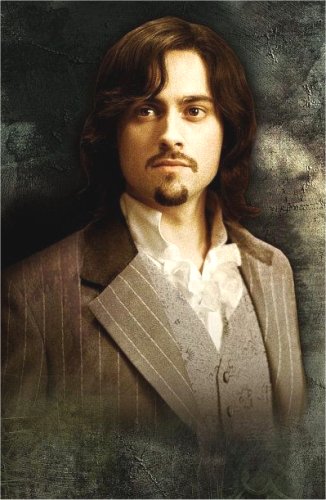
So The Picture of Dorian Gray... *sigh* I really do love this story even if the writing seems a bit muddy to me at times. However Oscar Wilde is famous for his elegant , if lengthy descriptions of the human soul and its reaction to acts of love. We often see in Dorian Gray, not just the statements of how love affects a person but of how the duplicity of the human soul can affect the very idea of love, or more often than not affection. Wilde's character, Lord Henry, stated "Those who are faithful know only the trivial side of love; it is the faithless who knows loves tragedies." (pg 14) I think that Wilde was making another statement about the human soul here, not that promiscuity was the way to go, as some of the contempories of his time believed, but a statement about loves naivety and how truly tragic love can be.
Now I love the idea's presented in pieces like Marlowe's Doctor Faustus and I can't help but see several similarities between classic Faust and Dorian Gray, and I believe that was something of a point made by Wilde. This Faustian tendency in literature of the time period was whole heartedly moralistic however I believe that Wilde had more than just simple morals on the mind when he wrote Dorian Gray. Personally I believe that Wilde was making a rather drastic set of statements on the tendencies of the English 'upper crust' to live a drastically duplicitous life. Where the idea of Victorian society was the important part no matter what vulgar or distasteful life they lived on their own. Which is only more amusing to me considering the later part of Wilde's life where he was persecuted for the life that he led but decided not to make as horribly blunt as everyone expected. Seriously though it's amazing to see Wilde's commentary on English society used against him in such a blatant fashion seeing as they even used passages from Dorian Gray in Wilde's trial in 1885. And I personally think that Wilde's defending quote from his own trial is one of the best breakdowns of the relationship between Dorian and Basil Hallward began as, "'The love that dare not speak its name" in this century is such a great affection of an elder for a younger man as there was between David and Jonathan, such as Plato made the very basis of his philosophy, and such as you find in the sonnets of Michelangelo and Shakespeare. It is that deep spiritual affection that is as pure as it is perfect. It dictates and pervades great works of art, like those of Shakespeare and Michelangelo, and those two letters of mine, such as they are. It is in this century misunderstood, so much misunderstood that it may be described as "the love that dare not speak its name."
In the end though everything breaks down. Every lie comes to truth, every act is examined for ulterior motives, and the duplicitous nature of nobility (according to Wilde) ends up being its own killer. It's funny sometimes the way that life and art are just different sides of the mirror, and you can never be sure exactly which side you're on.
Tuesday, March 2, 2010
To sleep perchance to dream.... of vampires!?
Well for the first time I read a piece of the after book analysis and I wasn't horribly disappointed by the over wordy nature of the piece, then again maybe that was just by some perceive witty remarks that I thought I found in there. Either way Michael Davis gave us a lot to think about. However since talking about everything that he went over would be not only longer than necessary, it would also most likely be duller than a doorknob. So on to the meat and potatoes.
One of my favorite bits in Davis' piece (including witty commentary) comes very near the end of page 232 and the top of page 233. Davis points out "Indeed Carmilla and her enigmatic messages, together with the anagrammatical lability of her ‘name’, are like the chimeras sold by the hunchback, ‘compounded of parts of monkeys, parrots, squirrels, fish, and hedgehogs, dried and stitched together with great neatness and startling effect’ (265); part of nature and yet beyond conventional meaning. (And is it too fanciful to suggest that ‘Carmilla’ and ‘chimera’ sound quite similar?) Thus, through the allegorising selfreflexivity of Le Fanu’s text we can see that Carmilla and the Gothic are chimerical hybrids, a stitching together of heterogeneous and thus profoundly enigmatic signifying materials." Personally I think that this is one of the most inherent things behind a truly Gothic piece of literature, being something horribly innocuous and yet totally terrifying. I decided to go and see what Wikipedia had to say about Gothic Literature, and sure enough they had a nice big list of the Prominent features of Gothic Fiction and, needless to say, the overwhelming majority of the list took place right here in Carmilla.
Now I'll jump around a little here, but that because I haven't taken enough psychology classes to make much sense some of the way that things worked out here, so I'll just stick to what I know for now. I'm not a big fan of Freud, but I know of a lot of his work. I am a big fan of Shakespeare, and I know a lot of his work as well. So when Davis stared explaining the Oedipal situation of Carmilla my mind started recognizing what he was talking about (right after it made a short leap to Oedipus Rex). Now I'll admit I was a little surprised to see the Oedipus references in this analysis, but that's mostly because I didn't see that type of relationship between Laura and her father. I saw and understood the slightly maternal interactions and relationship between Carmilla and Laura but I hadn't made the leap to Oedipal for her father, and it I missed something that he makes seem fairly obvious, I wonder where I missed it exactly.
Now one last note. I mentioned in my piece last week that I hadn't seen much of the interaction with Ireland in the stories or the characters, nor did I see an overt amount of Ireland in the stories that we had been reading. This isn't to say that I didn't see some of the political ramifications, nor the persecution of the relationship between the British, I just thought it wasn't the forefront of the pieces sometimes. I also made the point that, perhaps I wasn't seeing it because I wasn't part of the originally intended audience, and that's something that we often miss when reading over these pieces. We have the luxury of looking back on history and seeing what was going on at that time, but we weren't living it. We weren't living the subtleties of the daily interaction with the writers culture, as much as I wish I could have sometimes. So who knows, we all may be way off base with our analyses, and somewhere the authors are having a good ole giggle at us in the afterlife, or maybe we're dead on the money. Just things to contemplate as the nights wane by.
WS
One of my favorite bits in Davis' piece (including witty commentary) comes very near the end of page 232 and the top of page 233. Davis points out "Indeed Carmilla and her enigmatic messages, together with the anagrammatical lability of her ‘name’, are like the chimeras sold by the hunchback, ‘compounded of parts of monkeys, parrots, squirrels, fish, and hedgehogs, dried and stitched together with great neatness and startling effect’ (265); part of nature and yet beyond conventional meaning. (And is it too fanciful to suggest that ‘Carmilla’ and ‘chimera’ sound quite similar?) Thus, through the allegorising selfreflexivity of Le Fanu’s text we can see that Carmilla and the Gothic are chimerical hybrids, a stitching together of heterogeneous and thus profoundly enigmatic signifying materials." Personally I think that this is one of the most inherent things behind a truly Gothic piece of literature, being something horribly innocuous and yet totally terrifying. I decided to go and see what Wikipedia had to say about Gothic Literature, and sure enough they had a nice big list of the Prominent features of Gothic Fiction and, needless to say, the overwhelming majority of the list took place right here in Carmilla.
Now I'll jump around a little here, but that because I haven't taken enough psychology classes to make much sense some of the way that things worked out here, so I'll just stick to what I know for now. I'm not a big fan of Freud, but I know of a lot of his work. I am a big fan of Shakespeare, and I know a lot of his work as well. So when Davis stared explaining the Oedipal situation of Carmilla my mind started recognizing what he was talking about (right after it made a short leap to Oedipus Rex). Now I'll admit I was a little surprised to see the Oedipus references in this analysis, but that's mostly because I didn't see that type of relationship between Laura and her father. I saw and understood the slightly maternal interactions and relationship between Carmilla and Laura but I hadn't made the leap to Oedipal for her father, and it I missed something that he makes seem fairly obvious, I wonder where I missed it exactly.
Now one last note. I mentioned in my piece last week that I hadn't seen much of the interaction with Ireland in the stories or the characters, nor did I see an overt amount of Ireland in the stories that we had been reading. This isn't to say that I didn't see some of the political ramifications, nor the persecution of the relationship between the British, I just thought it wasn't the forefront of the pieces sometimes. I also made the point that, perhaps I wasn't seeing it because I wasn't part of the originally intended audience, and that's something that we often miss when reading over these pieces. We have the luxury of looking back on history and seeing what was going on at that time, but we weren't living it. We weren't living the subtleties of the daily interaction with the writers culture, as much as I wish I could have sometimes. So who knows, we all may be way off base with our analyses, and somewhere the authors are having a good ole giggle at us in the afterlife, or maybe we're dead on the money. Just things to contemplate as the nights wane by.
WS
Tuesday, February 23, 2010
Something wicked this way comes?
Now here is certainly a piece that I could sink my teeth into... okay bad pun I'll admit it. However it is completely appropriate considering that such an innocuously named piece was written about a vampire. Usually when you think vampire what comes to mind? Creepy castle? Check. Run down village? Check. Superstitious and vengeful family members of the victim(s)? Check and check several times over. It's nice to see some of what has become stereotypical of the vampire novel here before us, quite a bit before they were total stereotypes, and I will gleefully admit, those stereotypes were played out without hurting my brain.
I think one of my favorite moments in the piece was the story of the General's niece and her new friend. Yes of course we all knew what was happening and knew who was involved long before they got to the end of the story but it still made me snicker at the simplicity of disguise used in the entire piece. Masks at a Masquerade, a simple rearranging of letters, and then returning to her own hidden grave. I almost felt like I was playing hide and seek with the characters at times. Even more amusing I knew who the vampire was in one of the far earlier parts of the book, for even if I had questioned it Le Fanu threw the implications right into our faces in Chapter Three. "There was a sombre piece of tapestry opposite the foot of the bed, representing Cleopatra with the asps to her bosom;" clearly pointed us in the direction of everything that was going to happen, with our main character (aka Cleopatra) clutching a prized and favored being (aka the Asp), in this case Carmilla, to her chest without the consideration of its inherently deadly nature.
Now I'm not certain if Le Fanu was attempting to offer such a thin veil for his dramatic conclusions or if he really didn't believe that people would noticed the allusions to where and how Carmilla came about together. It was in chapter one that we were informed of the lay of the land including the nearest village. "because there is, only three miles westward, that is to say in the direction of General Spielsdorf’s schloss, a ruined village, with its quaint little church, now roofless, in the aisle of which are the mouldering tombs of the proud family of Karnstein, now extinct, who once owned the equally desolate chateau which, in the thick of the forest, overlooks the silent ruins of the town." And in Chapter Four, Carmilla discloses the only three facts about herself that she can: her name, her family's ancient and noble heritage, and the direction in which her home is. Add that to the discovery of the Mircalla's (read Carmilla's) painting. Three simple things put together to tell you that something isn't right here! Don't forget of course about the hunchback in Chapter Four as well who informed us about the strange situation of Carmilla's teeth.
Now considering that I'm a fan of vampire novels I'll once again say that this was, in my opinion, a good one. I can't say great considering that the original intended audience for this piece was nothing like myself, so I'm missing several of the nuisances of the piece I'm certain. I did however notice something rather interesting from the start of the novella, although written by an Irish novelist the main character had little if anything to do with Ireland itself, and neither did the story. It's a trend I've been noticing in the pieces, although this is an Irish novel there is almost no connection to Ireland itself, except perhaps in certain mannerisms of the vampires and the way that the peasants celebrated the death of their girls. Then again... those are just the things that pop into my mind while writing.
WS
I think one of my favorite moments in the piece was the story of the General's niece and her new friend. Yes of course we all knew what was happening and knew who was involved long before they got to the end of the story but it still made me snicker at the simplicity of disguise used in the entire piece. Masks at a Masquerade, a simple rearranging of letters, and then returning to her own hidden grave. I almost felt like I was playing hide and seek with the characters at times. Even more amusing I knew who the vampire was in one of the far earlier parts of the book, for even if I had questioned it Le Fanu threw the implications right into our faces in Chapter Three. "There was a sombre piece of tapestry opposite the foot of the bed, representing Cleopatra with the asps to her bosom;" clearly pointed us in the direction of everything that was going to happen, with our main character (aka Cleopatra) clutching a prized and favored being (aka the Asp), in this case Carmilla, to her chest without the consideration of its inherently deadly nature.
Now I'm not certain if Le Fanu was attempting to offer such a thin veil for his dramatic conclusions or if he really didn't believe that people would noticed the allusions to where and how Carmilla came about together. It was in chapter one that we were informed of the lay of the land including the nearest village. "because there is, only three miles westward, that is to say in the direction of General Spielsdorf’s schloss, a ruined village, with its quaint little church, now roofless, in the aisle of which are the mouldering tombs of the proud family of Karnstein, now extinct, who once owned the equally desolate chateau which, in the thick of the forest, overlooks the silent ruins of the town." And in Chapter Four, Carmilla discloses the only three facts about herself that she can: her name, her family's ancient and noble heritage, and the direction in which her home is. Add that to the discovery of the Mircalla's (read Carmilla's) painting. Three simple things put together to tell you that something isn't right here! Don't forget of course about the hunchback in Chapter Four as well who informed us about the strange situation of Carmilla's teeth.
Now considering that I'm a fan of vampire novels I'll once again say that this was, in my opinion, a good one. I can't say great considering that the original intended audience for this piece was nothing like myself, so I'm missing several of the nuisances of the piece I'm certain. I did however notice something rather interesting from the start of the novella, although written by an Irish novelist the main character had little if anything to do with Ireland itself, and neither did the story. It's a trend I've been noticing in the pieces, although this is an Irish novel there is almost no connection to Ireland itself, except perhaps in certain mannerisms of the vampires and the way that the peasants celebrated the death of their girls. Then again... those are just the things that pop into my mind while writing.
WS
Tuesday, February 16, 2010
Thank You Word of the Day Calendar!
Oh how I loathe thee, over verbose tacticians of written monotony. Seriously! Who has discussions like these? Why do they think anyone besides a college professor (no offense Teach) or other literary critics would appreciate this type of writing. Then again... maybe I'm just being cantankerous. (Yes I used that word in a sentence, correctly even.)
Although I plowed my way through, what I once again saw as unnecessary vocal drivel, I can't say that I was particularly enlightened by what was there. Seeing Edgeworth's writing characterized as little more than a vaudevillian tactic to drum up amusement and support was a bit disappointing. Seriously when Egenolf quoted Kenneth Lynn saying that "Edgeworth thus becomes a minstrel character, performing what Kenneth Lynn refers to as “a white imitation of a black imitation of a contented slave," I was slightly bothered. I've heard some people refer to the Irish as the blacks of Europe, but I can't imagine that a statement like this is being used without a slap in the face attitude. Then again I can only get so upset by it considering how much of America's own entertainment history shares such a common thread.
I think perhaps the most persuasive pieces in this article are those linking dialect and clothing to a subversive culture and attitude. I think one of the most amusing things presented for us is the story of Mary Leadbeater's friend "a loyalist officer, was able to safely travel by post in the midst of the revolution, “disguised in a round hat and great-coat over his regimentals." In my mind it just evokes series of amusing scenes from movies where the 'good guys' steal the 'bad guys' uniforms and sneak into places that they shouldn't be. To think that this tactic worked because someone at some point decided that a particular style of jacket was going to be considered quintessentially 'Irish' is absurd to me. Then again I wasn't living at that period of time so much of what I look back upon will seem rather foolish.
A lot of this article draws back onto my feelings that the level of English persecution and mockery truly harmed the culture of Ireland more than people give it credit. There seems to be a lot of poking fun or commenting on the ineffectual nature of the Irish rebellion of 1798, which to me, seems quite unnecessary. They seriously seems to trivialize the hundreds of reasons that the Irish had for rebelling with the although we get a glimpse that, indeed, some people did get it with James Alexander's “A Curious Letter, Supposed to Be Written by a Penitent Rebel" from Some Account of the First Apparent Symptoms of the Late Rebellion in the County of Kildare (1800). "Alexander offers a fairly scathing critique of the burning of Irish houses by the government and the practice’s certainty of creating more rebels," one which I had the pleasure of having on hand to point out the truth behind one of the largest unaddressed matters.
Then again these are just the random ramblings of a crazy college student, please discuss.
WS
Although I plowed my way through, what I once again saw as unnecessary vocal drivel, I can't say that I was particularly enlightened by what was there. Seeing Edgeworth's writing characterized as little more than a vaudevillian tactic to drum up amusement and support was a bit disappointing. Seriously when Egenolf quoted Kenneth Lynn saying that "Edgeworth thus becomes a minstrel character, performing what Kenneth Lynn refers to as “a white imitation of a black imitation of a contented slave," I was slightly bothered. I've heard some people refer to the Irish as the blacks of Europe, but I can't imagine that a statement like this is being used without a slap in the face attitude. Then again I can only get so upset by it considering how much of America's own entertainment history shares such a common thread.
I think perhaps the most persuasive pieces in this article are those linking dialect and clothing to a subversive culture and attitude. I think one of the most amusing things presented for us is the story of Mary Leadbeater's friend "a loyalist officer, was able to safely travel by post in the midst of the revolution, “disguised in a round hat and great-coat over his regimentals." In my mind it just evokes series of amusing scenes from movies where the 'good guys' steal the 'bad guys' uniforms and sneak into places that they shouldn't be. To think that this tactic worked because someone at some point decided that a particular style of jacket was going to be considered quintessentially 'Irish' is absurd to me. Then again I wasn't living at that period of time so much of what I look back upon will seem rather foolish.
A lot of this article draws back onto my feelings that the level of English persecution and mockery truly harmed the culture of Ireland more than people give it credit. There seems to be a lot of poking fun or commenting on the ineffectual nature of the Irish rebellion of 1798, which to me, seems quite unnecessary. They seriously seems to trivialize the hundreds of reasons that the Irish had for rebelling with the although we get a glimpse that, indeed, some people did get it with James Alexander's “A Curious Letter, Supposed to Be Written by a Penitent Rebel" from Some Account of the First Apparent Symptoms of the Late Rebellion in the County of Kildare (1800). "Alexander offers a fairly scathing critique of the burning of Irish houses by the government and the practice’s certainty of creating more rebels," one which I had the pleasure of having on hand to point out the truth behind one of the largest unaddressed matters.
Then again these are just the random ramblings of a crazy college student, please discuss.
WS
Tuesday, February 9, 2010
A Few Things Not To Do When You Become And Irish Lord
Castle Rackrent by Maria Edgeworth
You know there's a part of me that thinks of Thady like that crazy old uncle or neighbor that everyone has in their life. You know the one, the one that always has a story about everything great and small and how they were there for it. Or at least they know someone who was. I only wish their stories were as loyal as the ones that we got from Thady.
Now we're presented with a family that start with perhaps the quintessential Irish hero king, Sir Patrick, and we have to suffer through the bumbling misfortunes of his ill begotten line until we reach the tragic end with Sir Condy, who many people view as Sir Patrick reborn. What can we learn from this family?
1. Don't let your wife buy all the crazy baubles and dresses that she's grown accustomed to when you know your family is broke (Thank you Sir Condy).
2. Never wed for money, especially when your wife and her family will always have more than most of your country in the last ten years (Thank you Sir Kit.)
3. The law, even when it's on your side, doesn't make up for living a good life full of enjoyment (Thank you Sir Murtagh).
Now these are by no means the only lessons that we can learn from the Rackrent family, they give us so many opportunities to look at them and go, I will not be that guy. Please don't be that guy...
I think though that some of the best lessons in Edgeworth's satire comes more from Thady himself and how he deals with his place in the world. Seriously it must have been a blessing for him in that span of ever shifting masters to know that his place was there at their sides, that his loyalty was perhaps the greatest asset that these lords would ever have at their disposal. Thady couldn't even make him think poorly of the Lords of the Rackrent clan, and could barely justify such thoughts about their ladies. In the end the Rackrents were more his children than his own son.
Oh Jason... Of all the ills that befell Castle Rackrent and her denizens I doubt there was any as painful or as unsuspected as Jason M'Quirk. In the face of so many generations of family service Jason's supposed betrayal of not only the Rackrent clan, but of his own father, is something that any observant reader could have told you was coming from early in the tale and yet Edgeworth still makes us feel the bitter sting of his actions. Thady points it out himself on page 106 when he speaks of Jason "I wondered, for the life of me, how he could harden himself to do it; but then he had been studying the law, and had made himself attorney Quirk;". If we look back on when Sir Murtagh was in charge, who was himself and attorney, there was little in the way of joy that we could connect to and even less in the way that his family existed. It was sad to say the least that Jason couldn't learn from this preceding character's losses.
And I'm not certain that it was Edgeworth's intention that we reviled the women of the Rackrents in the way that I ended up doing. There were few if any traits that I could find in them to connect with. Although I could understand Sir Murtagh's bride and her frugality, I had no respect for the manner that she dealt with those who rented from her husband. Then there was Sir Kit's Jewish wife, who even in devout faith wouldn't give up her cross, and yet was it really faith or was it her shrewd sense of money. I pitied her more than anything, however I pitied Kit as well for wedding such an unyielding woman. And then there was the quandary of Judy M'Quirk and Miss Isabella. I think in the end Condy would have been happier, and perhaps even better off if he had wed where his heart told him to, with Judy, but he trusted to chance and eventually was ruined by the one that wanted him the most. Seriously Isabella had to be one of the flightiest girls in the book, with a theatrical response for everything. Did that really work during that time? Because seriously if it did, I'm living in the long era. Still there is almost nothing to find to love about these women when all is said and done and I can only think that Edgeworth was making a commentary about the women themselves as well as their lordly husbands.
All of this though is just observation and conjecture, of which I am becoming quite fond of. Sadly enough my favorite character is one that we barely get to see, Sir Patrick, who even in death had a merry song to sing and who reminds us not to take the world to seriously.
"He that goes to bed, and goes to bed sober,
Falls as the leaves do, falls as the leaves do, and dies in October;
But he that goes to be , and goes to be mellow,
Lives as he ought to do, lives as he ought to do, and dies an honest fellow."
WS
You know there's a part of me that thinks of Thady like that crazy old uncle or neighbor that everyone has in their life. You know the one, the one that always has a story about everything great and small and how they were there for it. Or at least they know someone who was. I only wish their stories were as loyal as the ones that we got from Thady.
Now we're presented with a family that start with perhaps the quintessential Irish hero king, Sir Patrick, and we have to suffer through the bumbling misfortunes of his ill begotten line until we reach the tragic end with Sir Condy, who many people view as Sir Patrick reborn. What can we learn from this family?
1. Don't let your wife buy all the crazy baubles and dresses that she's grown accustomed to when you know your family is broke (Thank you Sir Condy).
2. Never wed for money, especially when your wife and her family will always have more than most of your country in the last ten years (Thank you Sir Kit.)
3. The law, even when it's on your side, doesn't make up for living a good life full of enjoyment (Thank you Sir Murtagh).
Now these are by no means the only lessons that we can learn from the Rackrent family, they give us so many opportunities to look at them and go, I will not be that guy. Please don't be that guy...
I think though that some of the best lessons in Edgeworth's satire comes more from Thady himself and how he deals with his place in the world. Seriously it must have been a blessing for him in that span of ever shifting masters to know that his place was there at their sides, that his loyalty was perhaps the greatest asset that these lords would ever have at their disposal. Thady couldn't even make him think poorly of the Lords of the Rackrent clan, and could barely justify such thoughts about their ladies. In the end the Rackrents were more his children than his own son.
Oh Jason... Of all the ills that befell Castle Rackrent and her denizens I doubt there was any as painful or as unsuspected as Jason M'Quirk. In the face of so many generations of family service Jason's supposed betrayal of not only the Rackrent clan, but of his own father, is something that any observant reader could have told you was coming from early in the tale and yet Edgeworth still makes us feel the bitter sting of his actions. Thady points it out himself on page 106 when he speaks of Jason "I wondered, for the life of me, how he could harden himself to do it; but then he had been studying the law, and had made himself attorney Quirk;". If we look back on when Sir Murtagh was in charge, who was himself and attorney, there was little in the way of joy that we could connect to and even less in the way that his family existed. It was sad to say the least that Jason couldn't learn from this preceding character's losses.
And I'm not certain that it was Edgeworth's intention that we reviled the women of the Rackrents in the way that I ended up doing. There were few if any traits that I could find in them to connect with. Although I could understand Sir Murtagh's bride and her frugality, I had no respect for the manner that she dealt with those who rented from her husband. Then there was Sir Kit's Jewish wife, who even in devout faith wouldn't give up her cross, and yet was it really faith or was it her shrewd sense of money. I pitied her more than anything, however I pitied Kit as well for wedding such an unyielding woman. And then there was the quandary of Judy M'Quirk and Miss Isabella. I think in the end Condy would have been happier, and perhaps even better off if he had wed where his heart told him to, with Judy, but he trusted to chance and eventually was ruined by the one that wanted him the most. Seriously Isabella had to be one of the flightiest girls in the book, with a theatrical response for everything. Did that really work during that time? Because seriously if it did, I'm living in the long era. Still there is almost nothing to find to love about these women when all is said and done and I can only think that Edgeworth was making a commentary about the women themselves as well as their lordly husbands.
All of this though is just observation and conjecture, of which I am becoming quite fond of. Sadly enough my favorite character is one that we barely get to see, Sir Patrick, who even in death had a merry song to sing and who reminds us not to take the world to seriously.
"He that goes to bed, and goes to bed sober,
Falls as the leaves do, falls as the leaves do, and dies in October;
But he that goes to be , and goes to be mellow,
Lives as he ought to do, lives as he ought to do, and dies an honest fellow."
WS
Tuesday, February 2, 2010
One punch, Two Punch, I punch, You punch...
Violence and the Constitution of the Novel...
Also known as how to fry your brain like an egg.
Normally I don't find that I have a lot of problems with wordy pieces but I think that this one takes me well beyond my normal 'wordy piece'. I'm not exactly certain who David Lloyd was writing this piece for, however I take the fact that it was so overly verbose as meaning it wasn't meant for your average student. Now that being said I will give Mr. Lloyd plenty of credit for addressing perhaps some of the most touchy and difficult topics of Irish literature, much less culture.
One of the major topics that I actually took a bit of an interest in was the analysis of the subaltern culture and how it was possible for the Irish to be considered a subaltern group if we were "overstepping the limits of Gramsci's largely class-oriented thinking" (126), and not just the Irish. Several other groups were allowed to be considered subaltern in this extension of understanding, including those on a gender basis.
Now if I understood some of what Lloyd was saying correctly, a good portion of why the Irish were and in fact still are portrayed as overly violent has a great deal to do with their revolutionary relationship with the British Kingdom. Lloyd pointed out that "Violence is always without the law. For, within nationalist history, what was violence becomes, in Walter Benjamin's terms, 'sanctioned' and thereby ceases to be violence insofar as bloodshed is subordinated to the founding of the state." (126) If we look at that quote, keeping in mind the history and the manner in which history is written, it's no wonder that the Irish to the blunt end of the publicity stick to the proverbial face and still are till this day. There is no love lost between the Irish and the British but to see it stretch beyond the standard politic floor and bar bashing is a point of view that I hadn't considered. This very idea draws us back toward the idea of a subaltern group. In this case it follows Lloyd and Gramsci's direct line of thought where the 'dominant history' over rides almost all of the subaltern group, to anyone besides that group. To me this is just an obnoxiously over complicated way to say history is written by the victors.
I can only think that this idea is strengthened by Lloyd's statements on pg 142, where he is analyzing Bartlett's article on death's in Irish Conflicts. When Lloyd points out that "what might be called the economy of Irish violence seems literally improbable or illegitimate to English observers," he highlights the fact that the English, and if you look at it closely for the time period, the majority of the rest of the world, don't understand the necessary level of violence as part of a struggling society. It simply seems to the outsider that the Irish are violent to be violent, when in truth they're fighting for the necessities of life, which, according to Bartlett's numbers, were not often lost in the more agrarian disturbances of the time. This still placed an impression on the world at large which, once made, was nearly possible to undue.
After reading Lloyd's piece, my opinion states that a good portion of the reason that the Irish novel is often so rife with violence is due to simple misunderstandings and socio-political blackballing on the behalf of the British. In all honesty without the British fanning the flames of how, and I'm stating stereotypes here, uncouth and barbaric the Irish were in comparison to 'civil societies', I doubt that the overt violence would have held on for this long. Then again those are just my opinions.
Tuesday, January 26, 2010
Blog #1: January 26, 2010: Introductions
So welcome to the wonderful world of me, thank you for tuning in. Anyway let's start off with the introduction, my name is Kayla and I'm currently enrolled in English 263: Introduction to the Novel - the Irish Tradition. I'm an Art Technology major who has a dutifully cultural crush on the "emerald isle", which is a good chunk of why I'm in this course. I spend a lot of time in front of my computer lately, which works out well for this class in all actuality, however its usually for a less academic reason and a much dorkier one. Video games take up much of my computer time while I'm not being a bigger nerd and reading web comics, by the way I enjoy being a nerd so if you read web comics and play mmorpgs pleas don't take offense. I do take time away from my games to do things like read and draw, both of which I enjoy very much.
Now when I signed up for this class, besides being overly excited about seeing ''Irish Tradition" in the title, I looked at it as a way to expand my current reading selection. Usually when I pick up a novel, especially of late, I'm picking up one of a series, a very long series knowing me. One prime example, and another point of my geekdom, is the Wheel of Time series. When I saw a fantastic world available with powers beyond the human comprehension full of a rich tapestry of history so convoluted that only the author knew what was really going on in the creation of the world I was entranced. Usually that's the way it goes for me, books that take something similar to our everyday world and turns it on its head just enough to look familiar makes me a very happy reader. Also the episodic multi-book story arcs draw me in giving me a chance to not only learn about a character but to learn to love, or just as often hate, a character. It makes me feel like I know a portion of the author every time that I'm given such an in depth view of a character. When it comes to a less fantastic novel I'm bigger on the quirky twisting excitement of novels like Da Vinci Code or The Last Symbol, which take our world and gives us a possibility that most of us have never thought of. Unfortunately this makes it nearly impossible for me to pick a singular novel that I love more than the others. Suffice it to say that I have a handful that I hold dear.
Now this is one of two English classes that I'm enrolled in this semester. The other is actually about the Entertainment Arts and is a lecture/discussion style class, which is more in line with my major. These are also the first two English courses that I've been a part of since I graduated high school, which was not last year. However in high school English was one of my favorite subjects and I took vastly more of them than I was required to. My favorite one had to be British Authors but that's mostly the fault of Mr. Shakespeare and Mr. Chaucer. Now I don't expect those classes to be much help to me in these classes but then again, you never know when some tidbit of 'useless' information will actually come in handy, trust me I know, I'm full of 'useless' info. Take for the fact that I've studied Ireland, its history and mythology mostly, for my own curiosity. I honestly bought the nonessential books just because I was interested in what they had to say. Also, last semester, I was enrolled in Gaelic, the older traditional national language of Ireland. We spent a portion of our time learning about the culture so we understood a little better what we were saying and why. It also helps that I have a bit of Irish in my family background. I'm pretty sure that's where my interest originally comes from.
I will admit, at this time, that I am a member of the online community known as Myspace and I have been for several years. I will also say I have no intention of moving over to the latecomer known as Facebook. As for where else I run around on the net besides the crazy video game chats and forums I can be found on most major messengers as well as a nice little program called IRC. IRC is a constant chat program that is connected to a vast number of severs on which you can usually find someone who wants to talk about something you're interested in. I'm usually on a sever called DarkMyst on which my friends act as moderators. If you have any idea what I'm talking about poke at me and we can see if we know any of the same people. Otherwise I can usually be found lurking around http://www.hulu.com/ catching up on the pop culture that I've missed during the week. All I have to say about Hulu is that that goodness for not needing to fight my family for the record feature on the cable box.
Now a brief interlude with one of my favorite scenes from one of my favorite movies starring some of my favorite actors which I believe everyone should have the pleasure of seeing. Can you tell that I really like this movie? (Please note that there is a small amount of swearing in this clip, it is recommended that you watch away from small children.)And if I ever do get the pleasure of going to Ireland to actually explore the country that has stolen at least a portion of my heart I plan on going to some of the more famous locations, as well as the ones that no one ever talks about. One of the most famous in Dublin is a place called Temple Pub, because you can't go to Dublin and not have a drink.

Well that, at least, is a good start to the introductions of who is the me that is not you. Hopefully I'm not too horrible that you never ever want to speak to me again, or read anything that I have to say. Maybe just maybe we'll walk out of this understanding just a bit more about each other, or maybe I'll be reminded why my blogs have never lasted very long in the past. Still thank you for your time and enjoy the rest of you day/night/week/period of time.
WS
Subscribe to:
Comments (Atom)
